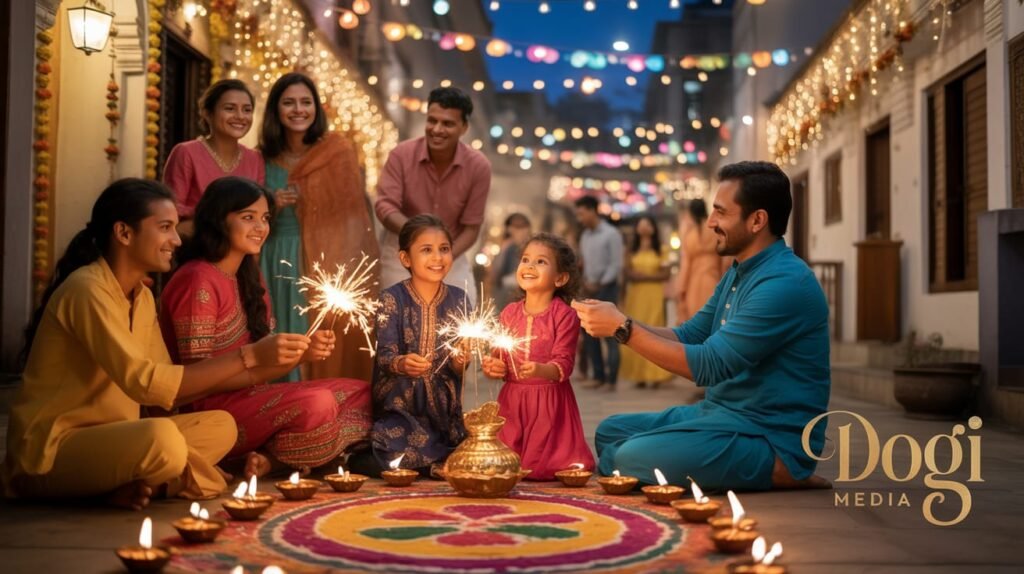
Introduction: A Festival of Lights That Brightens Every Heart
Every year, as the autumn breeze fills the air and the nights grow longer, millions of homes across India and beyond light up with diyas, lanterns, and laughter. This magical time marks the arrival of Diwali, the Festival of Lights.
Known for its vibrant celebrations, mouth-watering sweets, sparkling lights, and deep spiritual meaning, Diwali stands as one of the most important festivals in Indian culture.
But Diwali is not just about firecrackers or decorations—it is about the triumph of light over darkness, good over evil, and hope over despair.
In this blog, we’ll explore the history, traditions, spiritual meaning, and modern-day relevance of Diwali, while also discussing how to celebrate it responsibly and sustainably.
The Origin of Diwali: Legends That Illuminate Its Meaning
The Return of Lord Rama
One of the most popular legends behind Diwali comes from the Hindu epic Ramayana. It is said that Lord Rama, along with his wife Sita and brother Lakshman, returned to Ayodhya after 14 years of exile and after defeating the demon king Ravana.
To celebrate his return and the victory of good over evil, the people of Ayodhya lit thousands of diyas, turning the city into a sea of light. This marks the tradition of lighting lamps during Diwali, symbolizing the victory of light over darkness.
The Birth of Goddess Lakshmi
Another legend tells of Goddess Lakshmi, the goddess of wealth and prosperity, who emerged from the ocean during the churning of the cosmic sea (Samudra Manthan). Hence, Diwali also celebrates Lakshmi’s birth and her blessings upon humanity.
The Victory of Lord Krishna
In certain regions, Diwali marks Lord Krishna’s victory over the demon Narakasura, who had terrorized the world. Krishna freed the people from Narakasura’s evil reign, signifying the end of negativity and the beginning of peace.
Jain and Sikh Significance
For Jains, Diwali marks the nirvana (enlightenment) of Lord Mahavira.
For Sikhs, it is known as Bandi Chhor Divas, celebrating the day Guru Hargobind Ji was released from imprisonment, symbolizing freedom and justice.
Thus, Diwali unites diverse faiths and traditions, each with its own beautiful story that celebrates light, love, and liberation.
The Five Days of Diwali: A Journey from Darkness to Festival of Lights
Diwali is not a one-day celebration; it unfolds over five significant days, each holding unique meaning and rituals.
Dhanteras – The Day of Prosperity
The first day, Dhanteras, is considered highly auspicious for buying gold, silver, and new utensils. The word Dhan means wealth, and Teras refers to the thirteenth day of the lunar calendar.
On this day, people clean their homes, decorate entrances with rangoli, and pray to Goddess Lakshmi and Lord Dhanvantari for health and prosperity.
Naraka Chaturdashi (Chhoti Diwali) – The Day of Cleansing
The second day, also called Chhoti Diwali, marks the victory of Lord Krishna over Narakasura. It’s believed to be the day when we must remove negativity from our lives.
People take ritual oil baths, clean their surroundings, and prepare sweets to welcome positive energy.
Lakshmi Puja – The Main Day of Diwali
This is the most awaited day. Homes are illuminated with rows of diyas, families dress in new clothes, and Lakshmi Puja is performed in the evening to invite wealth and success.
People exchange gifts, light fireworks, and share sweets, making this night the heart of the celebration.
Govardhan Puja – The Day of Gratitude
The fourth day commemorates Lord Krishna lifting the Govardhan Hill to protect villagers from torrential rains. Devotees express gratitude for nature’s blessings and prepare a grand feast known as Annakut.
Bhai Dooj – The Bond of Siblings
The final day celebrates the bond between brothers and sisters. Sisters pray for their brothers’ well-being, and brothers give gifts in return.
It’s a day of affection, laughter, and family unity, ending the festival on a heartwarming note.
Rituals and Traditions: What Makes Diwali So Special
Cleaning and Decoration
Before Diwali, people clean their homes thoroughly, as cleanliness symbolizes the removal of negativity. Walls are repainted, and doors are decorated with torans (garlands) and rangoli designs.
Lighting Diyas and Candles
The lighting of diyas is the most symbolic part of Diwali. Every lamp represents hope, knowledge, and enlightenment. When lit together, they create a beautiful reminder that even one small light can drive away the darkness. Thats why this is called Festival of Lights
Lakshmi Puja
In the evening, families gather to worship Goddess Lakshmi, offering sweets, coins, and prayers for prosperity. The sound of bells and mantras fills the air with spiritual energy.
Sweets and Feasts
From laddoos to barfis, the exchange of sweets symbolizes spreading happiness. Traditional dishes like puri, sabzi, kheer, and gulab jamun make Diwali a true culinary celebration.
Fireworks and Festivities
Fireworks are a symbol of joy and celebration. However, in recent times, people are shifting toward eco-friendly and noise-free celebrations to protect the environment and animals.
The Deeper Meaning of Diwali: Beyond the Festival of Lights
Although Diwali is full of joy and color, its real beauty lies in its spiritual message. In fact, it is much more than a festival of lights. it is a celebration of inner awakening and positive transformation. It teaches us that light always triumphs over darkness, no matter how long the night may seem. Moreover, it reminds us that good deeds, honesty, and kindness always bring lasting peace and happiness.
At the same time, it inspires self-reflection, encouraging us to remove hatred, jealousy, and greed from our hearts. In addition, Diwali motivates us to replace negative thoughts with hope and compassion. Ultimately, the festival encourages every individual to light the lamp within, thereby filling our minds with wisdom, purity, and positivity.
Modern Celebrations: Diwali in Today’s World as Festival of Lights
Today, Diwali has become a global festival celebrated by millions of people across the world — not just Indians. Indeed, it has transformed into a universal symbol of light, joy, and togetherness. From London to New York, and from Dubai to Singapore, landmarks glow with vibrant lights, and communities unite to share the festive spirit. Clearly, Diwali’s essence has crossed borders, touching hearts everywhere.
In Urban India
In cities, people celebrate with grand decorations, office parties, and digital greetings. Moreover, shopping malls and local markets sparkle with festive lights, offering massive Diwali sales and discounts. At the same time, social media platforms buzz with posts, reels, and virtual wishes, allowing everyone to connect and spread happiness. Consequently, even those living far from home can feel the warmth of the celebration online.
In Rural India
In villages, Diwali still remains deeply traditional. Here, families light diyas outside mud houses, share homemade sweets with neighbors, and gather for folk songs and cultural dances. Furthermore, the night sky fills with the gentle glow of lamps, creating an atmosphere of peace and simplicity. Thus, while urban celebrations may focus on glamour and convenience, rural Diwali continues to preserve the festival’s authentic roots and timeless charm.
Global Celebrations
Countries like Nepal, Sri Lanka, Mauritius, Fiji, and the United Kingdom also celebrate Diwali with great enthusiasm. In fact, many global cities organize official Diwali festivals featuring lights, food stalls, and music, making it a truly international celebration of Indian culture. As a result, Diwali has evolved into not just a religious event but a global symbol of unity, positivity, and peace.
Eco-Friendly Diwali: Lighting Up Responsibly
While Diwali is a time of joy, it often brings environmental challenges due to pollution and waste. Fortunately, people are now adopting eco-friendly ways to celebrate:
Use Clay Diyas Instead of Plastic Lights
Clay diyas are biodegradable, traditional, and add an authentic charm.
Avoid Loud Firecrackers
Choose green crackers or skip them entirely to protect pets and nature.
Make Natural Rangoli
Use flowers, rice flour, or turmeric instead of synthetic colors.
Gift Plants or Handmade Products
Eco-conscious gifting promotes sustainability and supports local artisans.
Reduce Food Waste
Share extra food with those in need, making your Diwali meaningful.
With these small steps, we can ensure that our celebration shines brightly without dimming the planet’s light.
The Economic and Social Impact of Diwali
Boosting the Economy
Diwali is one of India’s largest shopping seasons. The sale of clothes, electronics, sweets, jewelry, and decor items surges, contributing significantly to the economy.
E-commerce platforms like Amazon and Flipkart record massive growth during Diwali sales, while small businesses and artisans also thrive.
Strengthening Social Bonds
Diwali is also about reconnecting with people. Families reunite, old friendships rekindle, and communities come together in joy and kindness and Festival of Lights.
Even corporate offices celebrate Diwali with team gatherings, gifts, and decorations to boost employee morale.
The Role of Technology in Diwali
Technology has transformed the way people celebrate. Now, virtual pujas, digital gifts, and online greetings allow families separated by distance to stay connected.
Social media platforms flood with Diwali reels, creative campaigns, and festive filters, spreading joy of Festival of Lights globally in seconds.
However, despite modernization, the essence of Diwali remains unchanged—a celebration of love, light, and togetherness.
Diwali Around the World: A Global Glow
In the United Kingdom, the streets of Leicester and London come alive with dazzling parades and celebrations, as the Festival of Lights is embraced with great enthusiasm. Furthermore, homes and temples are illuminated beautifully, symbolizing the victory of light over darkness.
Meanwhile, in Nepal, Diwali is celebrated as Tihar, where dogs, cows, and crows are not only honored but also worshipped with garlands and treats, reflecting gratitude and harmony with all living beings.
Similarly, in Thailand, the festival takes the form of Loi Krathong, where people float delicately decorated baskets on rivers, creating a breathtaking scene of glowing lights drifting on the water.
Moreover, in Trinidad, Fiji, and South Africa, Indian communities joyfully mark Diwali with fireworks, feasts, and cultural performances, ensuring that traditions remain alive even far from their homeland.
Altogether, this global celebration beautifully illustrates how Diwali’s timeless message of light, hope, and unity transcends cultures, continents, and borders.
The Spirit of Giving: Diwali and Charity
One of the most heartwarming aspects of Diwali is daan (charity). Many people donate food, clothes, or money to those in need, believing that true happiness comes from sharing.
NGOs and social organizations also host drives for underprivileged families, ensuring that everyone experiences the festival’s joy.
This selfless spirit reminds us that Diwali is not just about wealth or lights—it’s about spreading love and humanity.
How to Celebrate Diwali Mindfully
Here are a few ways to make your Diwali more meaningful:
Spend quality time with family instead of focusing only on parties.
Support local artisans by buying handmade decor or sweets.
Avoid overconsumption and waste.
Practice gratitude — reflect on the good things in your life.
Share happiness with those who might be celebrating alone.
By celebrating mindfully, we reconnect with the true purpose of Diwali — to bring light not just into homes, but into hearts.
Conclusion: Lighting the Lamp Within
As the diyas flicker and fireworks burst across the sky, Diwali reminds us of one timeless truth — light can conquer any darkness.
This festival teaches hope when life feels uncertain, courage when challenges arise, and love when differences divide us.
Whether it’s a small diya in a corner or the glow of millions of lamps across cities, every light tells a story of renewal, unity, and faith.
So this Diwali, let’s celebrate not just with lights and sweets, but with kindness, awareness, and gratitude.
Let’s promise to keep the flame of goodness burning—today and always.
Read More Blogs : https://dogimedia.com/blog/
Subscribe Now : https://youtube.com/@xworldconsultancy
Follow Us On Instagram : https://www.instagram.com/xworldconsultancy
Follow Us On X : https://x.com/xwconsultancy
ремонт водонагреватель https://remont-boyler-na-domu.ru/