Introduction: Why Women’s Safety is a Defining Issue
Women’s safety has always been one of the most urgent social concerns in India, and it continues to shape national conversations. For decades, the nation has witnessed continuous debates, widespread protests, and several reforms aimed at making public spaces safer for women. However, progress has often been slow, and inconsistent implementation has limited long-term impact. At the same time, civic campaigns and mass awareness programs have started gaining momentum, ensuring that the issue stays alive in public discourse. Among these initiatives, Mission Shakti 5 has emerged as a large-scale effort that brings together government agencies, civil society, law enforcement, and communities in a shared vision.
Mission Shakti 5 is not just another campaign; instead, it symbolizes how collective civic participation, when combined with state policies, can inspire confidence among women and strengthen public trust in safety measures. Moreover, it highlights how awareness efforts and community engagement can generate larger conversations on gender equality and social transformation. To fully appreciate its influence, it is important to examine its objectives, strategies, achievements, and the way it has reshaped both public opinion and policymaking.
Understanding Mission Shakti: From Inception to Phase 5
The Origins of Mission Shakti
Mission Shakti was first introduced as a government-backed program to strengthen women’s safety and empowerment. Initially, it was seen as a response to growing concerns about crimes against women, particularly in urban spaces. Over time, it developed into a multi-dimensional campaign with a focus on:
Women’s safety in public spaces
Legal awareness
Gender sensitivity in policing
Public participation and community vigilance
Evolution into Mission Shakti 5
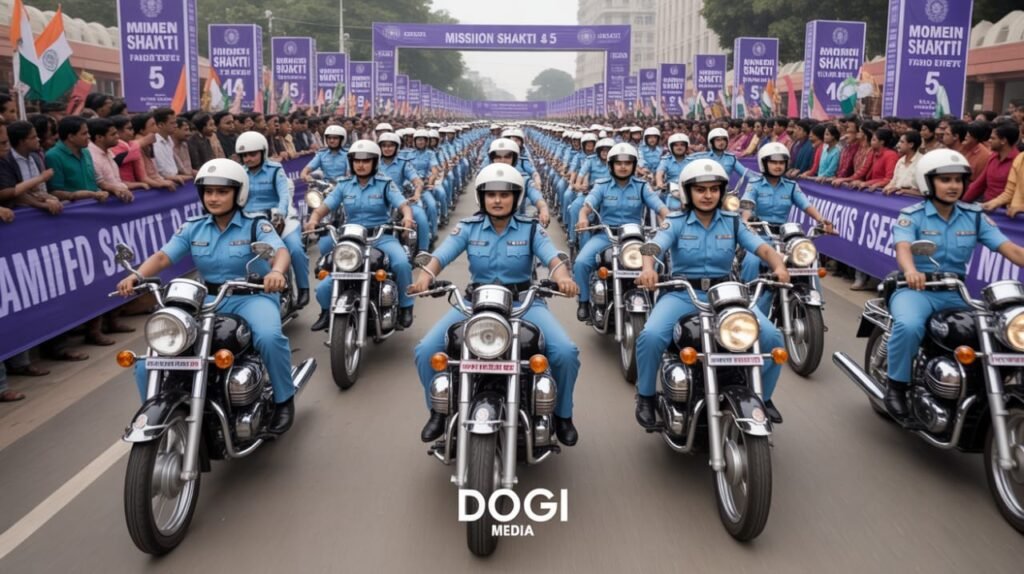
As earlier phases gained traction, Mission Shakti evolved into a recurring initiative that expanded its scale and outreach. Mission Shakti 5 represents the latest chapter, where the campaign has moved beyond traditional rallies and workshops to adopt innovative methods of awareness-building. For instance, large bike rallies with thousands of women police personnel have drawn significant public attention, creating powerful visual symbols of solidarity and empowerment.
Moreover, this phase has emphasized active involvement of schools, colleges, NGOs, and digital platforms. By doing so, it bridges the gap between policy-level directives and grassroots-level awareness.
Symbolism and Impact of the Mission Shakti 5 Bike Rally
One of the most striking moments of Mission Shakti 5 was the massive bike rally featuring nearly 18,000 women police officers across Uttar Pradesh. The sheer scale of this event was not only symbolic but also transformative.
Why the Rally Mattered
Visibility: When thousands of women officers ride together through city streets, it creates an unforgettable image of strength and unity.
Confidence Building: Such events reassure women that the system acknowledges their concerns and is committed to protecting them.
Media Amplification: The rally received nationwide media coverage, ensuring that the message of women’s safety reached millions.
Beyond Symbolism
Although rallies and public gatherings often carry symbolic value, their real strength lies in sparking conversations. Following the Mission Shakti 5 rally, debates around women’s safety resurfaced in television discussions, social media platforms, and community forums. People began questioning not only the role of the state but also their own responsibility in ensuring safer environments for women.
Civic Campaigns and Their Role in Social Transformation For Women’s Safety
The Power of Public Participation
Campaigns like Mission Shakti 5 underline the importance of collective civic action. When citizens, police, and civil society organizations participate actively, social change becomes more visible. Civic campaigns amplify voices that might otherwise go unheard.
Normalizing Women in Leadership Roles
Another remarkable outcome of Mission Shakti 5 is the normalization of women in uniform, occupying leadership positions in public events. For young girls, seeing women police officers lead rallies and awareness drives reinforces the belief that they too can aspire to such roles.
Engaging Youth and Educational Institutions
Colleges and schools have been engaged in seminars, debates, and workshops under Mission Shakti. This ensures that the younger generation grows up with a strong sense of gender equality and social responsibility. The ripple effect of such awareness drives is far-reaching, as today’s students are tomorrow’s professionals, leaders, and policymakers.
Transition from Awareness to Accountability
Policies vs. Practices
While awareness campaigns are necessary, they are insufficient if not followed by accountability. Mission Shakti 5 attempts to balance both. It emphasizes not just creating awareness but also ensuring stricter law enforcement, quicker response systems, and improved safety infrastructure.
Helplines and Technological Tools
Mission Shakti has been linked with dedicated helplines, emergency response apps, and community policing systems. These technological solutions are vital in transforming the campaign from a symbolic event into a tangible support system for women in distress.
Police Training and Gender Sensitization
Another layer of accountability lies in sensitizing law enforcement. Mission Shakti 5 has put a spotlight on training police officers in gender sensitivity, ensuring that victims are treated with empathy and respect when they approach law enforcement agencies.
Challenges and Criticisms of Women’s Safety
Despite its achievements, Mission Shakti 5 has not been free from criticism. Civic campaigns often walk a fine line between symbolism and genuine structural change.
Key Challenges Include:
Sustainability: Can such large-scale rallies and campaigns be sustained year after year, or do they risk becoming one-time spectacles?
Implementation Gaps: Laws exist on paper, but enforcement remains uneven across regions.
Rural vs. Urban Divide: While cities see massive rallies and campaigns, rural areas often struggle with deeply ingrained social norms and lack of infrastructure.
Public Apathy: Sustaining public engagement is difficult once the immediate media spotlight fades.
The Role of Media in Shaping Public Discourse
Traditional Media
Television channels, newspapers, and radio have played a crucial role in broadcasting the scale of Mission Shakti 5. Headlines describing “18,000 women police officers riding together” instantly grab attention and push the issue of women’s safety to the forefront of national discussions. These visuals make the problem impossible to ignore, and they encourage audiences to reflect on how collective action can create real change. At the same time, repeated coverage reinforces the urgency of addressing women’s safety at both local and national levels.
Social Media
Platforms like Twitter, Instagram, and Facebook have amplified the campaign further. Hashtags and short videos shared during the rallies have reached millions of people, sparking debates and encouraging user-generated content around women’s safety. Consequently, the message travels faster and creates an ongoing dialogue that extends far beyond the duration of the rally itself. This digital amplification not only spreads awareness but also motivates individuals to participate in similar civic initiatives.
Media as Watchdog
More importantly, media continues to serve as a watchdog, questioning whether campaigns like Mission Shakti are followed by genuine policy changes. This scrutiny ensures that the conversation does not remain superficial and compels policymakers to remain accountable. Therefore, media acts both as a promoter of awareness and as a guardian of accountability, making it a crucial partner in shaping public discourse.
Comparing Mission Shakti 5 with Other Women’s Safety Campaigns
India has seen multiple campaigns aimed at women’s safety, including Beti Bachao Beti Padhao, Nirbhaya Fund initiatives, and several NGO-led programs. While these efforts have made valuable contributions, Mission Shakti 5 stands out for several reasons. It involves the direct participation of women in uniform, which gives the campaign credibility and power that purely policy-driven initiatives often lack. Furthermore, it operates on a massive scale, making its presence impossible to ignore and ensuring that conversations on women’s safety remain at the center of public attention.
In addition, Mission Shakti 5 integrates both symbolism and systemic action by combining awareness drives with concrete measures such as helplines and training programs. As a result, it moves beyond awareness alone and begins to create mechanisms for accountability and long-term change. Compared globally, similar campaigns in countries like Sweden, Canada, and the UK focus more on legal reforms and workplace safety. Mission Shakti 5, however, places heavy emphasis on public visibility and community involvement, making it uniquely suited to India’s socio-cultural context.
Public Discourse: What Has Changed?
The real success of Mission Shakti 5 lies in its ability to shift conversations around women’s safety from reactive to proactive approaches. Before such campaigns, discussions on this issue often emerged only after tragic incidents, but now people are beginning to focus on preventing crimes instead of just responding to them. This change reflects a significant transformation in the way society views responsibility for women’s safety. People are no longer treating it as an individual concern alone; instead, it is increasingly being seen as a collective responsibility of communities, institutions, and governments.
At the same time, the campaign has encouraged a cultural shift from silence to open dialogue. Social media platforms are buzzing with conversations on gender equality, workplace harassment, and safe commuting, creating a continuous cycle of awareness and accountability. Together, these changes demonstrate that Mission Shakti 5 has not only raised awareness but has also reshaped public discourse by embedding women’s safety into everyday conversations.
Recommendations for the Future
While Mission Shakti 5 has been impactful, its long-term success will depend on how well it evolves. Some recommendations include:
- Expand Beyond Urban Centers: Take the campaign deeper into rural areas through community meetings, street plays, and grassroots mobilization.
- Digital Safety Campaigns: With rising cybercrimes, integrating digital safety awareness is crucial.
- Continuous Engagement: Instead of one-off rallies, sustain momentum through monthly or quarterly events.
- Collaboration with NGOs: Partnering with women’s rights organizations can make the campaign more inclusive and effective.
- Independent Evaluation: Regular third-party assessments can measure actual impact on women’s safety and ensure accountability.
Conclusion: Mission Shakti 5 as a Catalyst for Change
Mission Shakti 5 has shown that women’s safety cannot be addressed through isolated laws or occasional debates. Instead, it requires a holistic approach that combines symbolism, awareness, civic participation, law enforcement, and policy reform. The campaign’s visibility has sparked renewed public discourse, reminding society that women’s safety is not a luxury but a necessity.
As more women step into leadership roles and communities take responsibility, campaigns like Mission Shakti 5 can act as catalysts for long-term transformation. If sustained and expanded, they hold the potential to not only make India safer for women but also to set a global example of how civic campaigns can reshape social narratives.
Read More Blogs : https://dogimedia.com/blog/
Subscribe Now : https://youtube.com/@xworldconsultancy
Follow Us On Instagram : https://www.instagram.com/xworldconsultancy
Follow Us On X : https://x.com/xwconsultancy
vegan thc chocolates for ethical and plant based enjoyment